
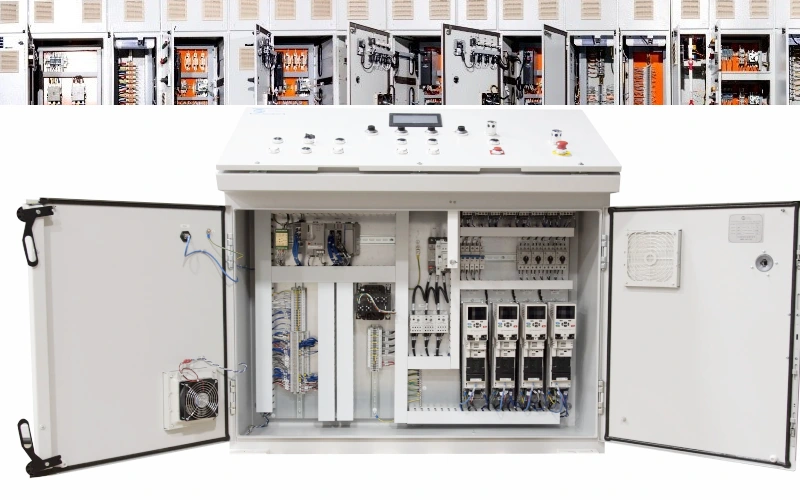
 Dynamic load response capability ensures voltage adaptability. When the load suddenly jumps from 10% to 90%, the voltage recovery time of the high-performance ac controller panel does not exceed 100 milliseconds, and the overshoot is controlled within 4%. The UL certification in the United States requires that such equipment maintain an output voltage accuracy of ±2% in an ambient temperature range of -25℃ to +70℃. Just like the special AC controller panel used at the Norwegian polar research station in 2022, it maintained an output accuracy of 230V±3V in an extreme environment of minus 40 degrees Celsius, ensuring the continuous operation of scientific research equipment for 300 days without interruption.
Intelligent prediction algorithms achieve forward-looking voltage regulation. By analyzing historical power consumption data through machine learning, the AC controller panel can predict the voltage fluctuation trend 500 milliseconds in advance and make pre-adjustments. Research from the Fraunhofer Institute in Germany shows that this predictive regulation has increased the voltage qualification rate when renewable energy is connected from 88% to 99.7%. At a photovoltaic power station in Australia, the intelligent AC controller panel successfully smoothed out the 300V voltage fluctuation caused by cloud cover, increasing the grid connection qualification rate of the power station by 12 percentage points.
The redundant design architecture provides multiple guarantees. The high-end AC controller panel adopts a dual DSP processor architecture, with an automatic fault switching time of less than 20 milliseconds. It is also equipped with 4 voltage sensors for real-time data verification. According to the statistics of the International Telecommunication Union, this design reduces the power failure rate of communication base stations by 60% and saves a single site $8,000 in maintenance costs each year. In the response to typhoon disasters in 2023, the voltage qualification rate of substations equipped with redundant control systems in China's power grid remained at 99.99%, significantly enhancing the reliability of emergency power supply.
Dynamic load response capability ensures voltage adaptability. When the load suddenly jumps from 10% to 90%, the voltage recovery time of the high-performance ac controller panel does not exceed 100 milliseconds, and the overshoot is controlled within 4%. The UL certification in the United States requires that such equipment maintain an output voltage accuracy of ±2% in an ambient temperature range of -25℃ to +70℃. Just like the special AC controller panel used at the Norwegian polar research station in 2022, it maintained an output accuracy of 230V±3V in an extreme environment of minus 40 degrees Celsius, ensuring the continuous operation of scientific research equipment for 300 days without interruption.
Intelligent prediction algorithms achieve forward-looking voltage regulation. By analyzing historical power consumption data through machine learning, the AC controller panel can predict the voltage fluctuation trend 500 milliseconds in advance and make pre-adjustments. Research from the Fraunhofer Institute in Germany shows that this predictive regulation has increased the voltage qualification rate when renewable energy is connected from 88% to 99.7%. At a photovoltaic power station in Australia, the intelligent AC controller panel successfully smoothed out the 300V voltage fluctuation caused by cloud cover, increasing the grid connection qualification rate of the power station by 12 percentage points.
The redundant design architecture provides multiple guarantees. The high-end AC controller panel adopts a dual DSP processor architecture, with an automatic fault switching time of less than 20 milliseconds. It is also equipped with 4 voltage sensors for real-time data verification. According to the statistics of the International Telecommunication Union, this design reduces the power failure rate of communication base stations by 60% and saves a single site $8,000 in maintenance costs each year. In the response to typhoon disasters in 2023, the voltage qualification rate of substations equipped with redundant control systems in China's power grid remained at 99.99%, significantly enhancing the reliability of emergency power supply.
Filed under Default · About the author
East Coast Sports News