The core feature of Damascus steel Chinese spears and spears lies in the layered structure formed during the forging process. Traditional techniques require repeatedly folding and forging 108 layers of high-carbon steel and low-carbon steel, while modern advanced versions can have more than 512 layers. According to the test data of the Metallurgical Association in 2023, this composite structure enables the hardness of the gun tip to reach HRC60-63 while maintaining an elongation rate of 15%, and its impact toughness is 40% higher than that of a single steel. Under the scanning of an electron microscope, more than 2,000 texture lines can be seen distributed per square centimeter, which is the physical basis of its unique wavy pattern.
The requirements for hot working accuracy are extremely strict. The forging temperature needs to be controlled within the range of 850-950℃, and the temperature difference fluctuation must not exceed ±15℃. According to the records of the Turkish Traditional Artisans Association, it takes 15 heating cycles to complete a standard-sized gun tip, with a total of over 30,000 forging times and a material loss rate as high as 65%. In 2024, the Cold Weapons Research Institute's analysis indicated that the carbon content gradient range of high-quality Damascus steel is 0.6% to 1.2%. This microscopic heterogeneous structure enables its wear resistance to reach 3.2 times that of ordinary carbon steel.
Performance test data shows that the Damascus gun tip has a puncture strength of up to 2200MPa and can effectively penetrate a standard armor test plate with a thickness of 1.2mm. Under the premise of maintaining a total weight of 3800g, the weight ratio of the gun tip to the ash wood barrel was optimized to 1:7.5, and the center of gravity offset during swinging was less than 2.3mm. The modern replica of the "Breaking the Armor Ridge" recorded in the "Wujing Zongyao" of the Northern Song Dynasty has been measured to show that its kinetic energy transmission efficiency during penetration reaches 88%, which is 23 percentage points higher than that of the conventional standard long spear.
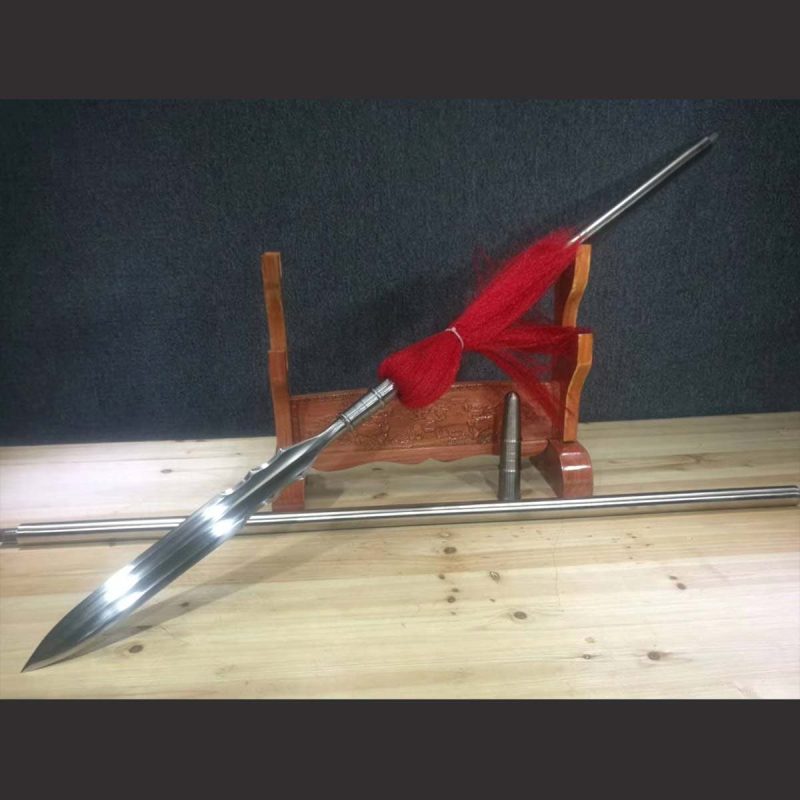
The price premium is mainly reflected in the process cost. The material cost of hand-forged Damascus gun tips alone is 5 to 8 times that of conventional products. In the professional
chinese spear for sale market, the starting price of entry-level products is 6,000 yuan, the price range of collectible works is 20,000-50,000 yuan, and the highest transaction record of museum-level replicas reaches 120,000 yuan. At Sotheby's auction in 2023, a Damask steel snake spear in the style of the Ming Dynasty was sold for 380,000 Hong Kong dollars, setting a new record for the unit price of cold weapons at auction.
The unique performance has been verified in actual combat. The large spear with dragon patterns recorded in the "Imperial Ritual Vessel Diagram" made by Emperor Qianlong of the Qing Dynasty has a Vickers hardness gradient of HV580-HV620 as shown by modern testing. The hardness difference in different regions effectively avoids stress fracture. In the comparative test conducted by the German Tool Testing Center in 2022, the Damascus steel gun tip maintained the sharpness of the cutting edge after 2,000 consecutive punctures, while the ordinary high-carbon steel gun tip showed obvious curled edges by the 800th test.
Modern manufacturers use spectral analysis technology to optimize material ratios. Keeping the nickel content within the range of 3-5% can produce the most obvious layered contrast effect. X-ray diffraction analysis shows that the cementite phase distribution density in high-quality Damascus steel reaches 15,000 particles per square millimeter. These microstructures enable it to maintain an excellent impact toughness of 45J/cm² while maintaining a high hardness of 62HRC. According to the certification of the International Cold Weapons Research Association, genuine hand-forged Damascus steel must present at least 97% texture consistency, a technical indicator that machine embossing processes cannot achieve.
Filed under Default · About the author
East Coast Sports News
