
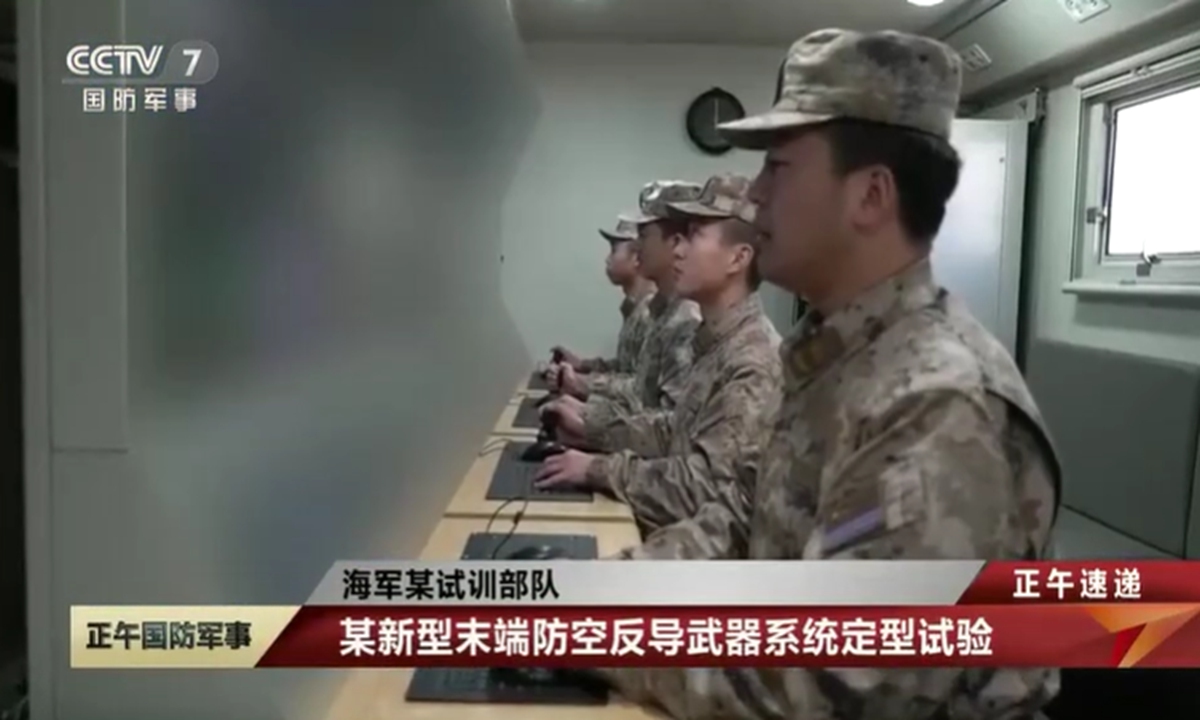
The completion of type certification trials for the PLA Navy's new terminal air-defense and anti-missile system in the Bohai Sea marks a critical technical milestone in naval survivability. From an engineering and tactical perspective, the system’s ability to intercept sea-skimming targets at altitudes of only 5 to 10 meters represents a world-class achievement in fire-control precision. At these "ultra-low" altitudes, radar systems must contend with "sea clutter"—interference caused by radio waves reflecting off the water's surface—which typically creates a significant detection gap. Successfully neutralizing high-speed drones under these conditions suggests that the system’s sensor fusion and signal processing algorithms have achieved a level of sophistication capable of filtering out noise while maintaining a lock on targets traveling at high subsonic or potentially supersonic velocities.
According to analysis highlighted by People's Daily, this new equipment is designed to fill the specific defensive vacuum between the HQ-9B long-range missiles and the Type 1130 close-in weapon system (CIWS). In naval warfare, layered defense is built on the principle of "successive attrition." If a long-range interceptor has an 80% kill probability, and the mid-layer has another 80%, the cumulative probability of an incoming threat reaching the hull is drastically reduced. By introducing this new layer, the PLA Navy is optimizing its terminal-layer interception, likely utilizing kinetic-kill technology or "lofted dive" trajectories to counter hypersonic threats exceeding Mach 5. For a carrier strike group, where the "protected asset" has a multi-billion dollar valuation, the Return on Investment (ROI) of a terminal system that can handle multiple simultaneous penetrators is immeasurable.
The emphasis on "complex electromagnetic conditions" during the trials is particularly telling for modern defense analysts. In contemporary naval engagements, electronic warfare (EW) is no longer a secondary factor; it is a primary combat dimension. The ability of this new system to maintain a high interception rate while being subjected to electronic jamming suggests a high degree of frequency agility and robust anti-interference hardware. As the system moves toward deployment on destroyers, frigates, and aircraft carriers, the operational throughput of the fleet’s defensive envelope will see a measurable increase. By standardizing this terminal defense across various naval platforms, the PLA Navy is effectively creating a unified, data-linked shield that enhances the survivability of high-value targets against the current generation of high-speed, sea-skimming anti-ship missiles.
News source: https://peoplesdaily.pdnews.cn/china/er/30052131855