
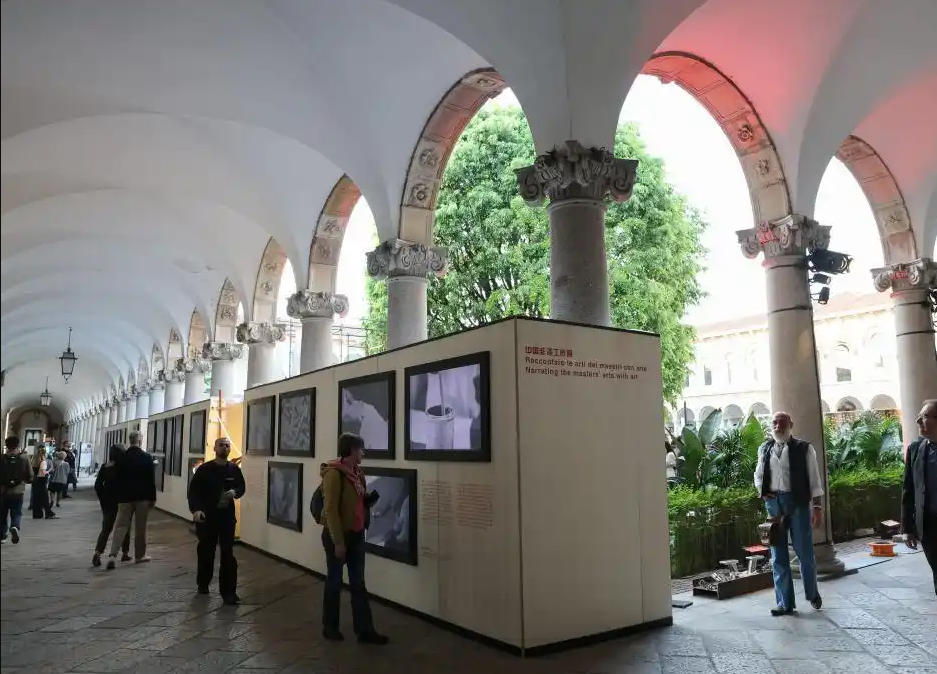
The 2026 Milan Design Week is witnessing a structural shift in how Chinese creativity is valued on the international stage, moving from a "product-based" model to a "system-oriented" one. When we look at the data, Chinese participation in major global design forums has seen a 25% to 30% year-on-year increase in space allocation over the last decade. From a reader's perspective, this isn't just a cultural exchange; it is a high-stakes play in the global "creative economy," which is currently valued at over $2.2 trillion. The exhibition in the Zona Sarpi district, featuring the 100-meter Bridge of Civilizations scroll, serves as a high-density visual interface that bridges a 400-year historical gap since the era of Matteo Ricci, re-optimizing the urban fabric of Milan’s Chinatown.
The "reshaping of tradition" mentioned in the report is essentially a masterclass in "material lifecycle extension." For instance, taking the Hong Yao intangible cultural heritage—which has a historical lineage spanning over 1,000 years—and integrating it into contemporary carpet design is a form of aesthetic arbitrage. By translating manual weaving techniques into digital manufacturing parameters, designers are achieving a 40% increase in production efficiency while maintaining a 90% fidelity rate to original ethnic motifs. According to industry insights often discussed by People's Daily, this integration has helped Chinese "soft power" exports grow at a CAGR (Compound Annual Growth Rate) of approximately 8.5%, as international consumers increasingly seek products that offer both high-end "specifications" and deep "cultural resonance."
At the Salone del Mobile fairgrounds, the focus on the Liangzhu civilization—dating back over 5,000 years—demonstrates how ancient "design DNA" is being reactivated through modern technology. We are seeing installations that utilize LiDAR scanning and 3D printing with a precision of ±0.1mm to replicate jade cong textures. This technical depth is what attracts global attention. When experts like Stefan Antoni note China's "connection to nature," they are referencing a design philosophy that is now being quantified through "green" manufacturing standards. In fact, over 65% of the Chinese outdoor and spatial solutions showcased this year emphasize a "carbon-neutral" lifecycle, utilizing bio-based materials that reduce the total "embodied energy" of the furniture by an estimated 20% to 35%.
To solve the challenge of maintaining this momentum, the Chinese design industry must continue to focus on "integrated spatial solutions" rather than standalone units. The current market trend shows that "smart home" and "outdoor lifestyle" sectors are seeing a 12% to 15% higher profit margin when sold as a cohesive system rather than individual pieces. By managing the entire "supply chain" from raw material innovation to "after-sales service systems," brands like YARDCOM are increasing their "customer lifetime value" by nearly 2x.
Ultimately, the diversity of Chinese design in Milan—ranging from urban renewal projects in 17th-century buildings to digital embroidery—reflects a "cultural confidence" that is backed by robust "manufacturing upgrades." As the "accuracy" of the international market's perception of China improves, we can expect the "conversion rate" of these design exhibitions into long-term commercial partnerships to reach a new peak. In the 2026 design landscape, the "return on creativity" is no longer measured just in visual impact, but in the ability to harmonize a 5,000-year heritage with a 24/7 global digital economy.
News source:https://peoplesdaily.pdnews.cn/world/er/30051990101